Classical music is more than a genre—it’s a canvas for storytelling, emotion, and imagination. It is a foundational approach to learning current era music by studying the past. Classical music offers a rich palette for poetic and expressive development; while also yielding a wide ability for playing, listening, and connecting.
🎶 Key Characteristics
- Written tradition: Composers use notation to preserve and communicate their music.
- Complex forms: Sonatas, symphonies, concertos, fugues—each with its own architecture / structure.
- Expressive range: From intimate solo pieces to grand orchestral works.
- Cultural depth: Often tied to philosophical, religious, or poetic ideas.
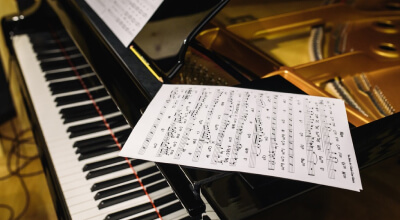
What is classical music? It’s basically written music in a score (staff, grand staff, notes). Because the works are written down, this music also embodies history. A library of works were created during these below eras:
- Medieval & Renaissance: Ideal for invoking mysticism, ritual, and ancient storytelling.
- Dates: 500-1600 includes sacred chants & vocal richness
- Must hear: Palestrina
- Baroque: Perfect for dramatic contrasts—light vs. dark, tension vs. release.
- Dates: 1600-1750 includes ornamentation, contrapuntal themes
- Must hear: Bach, Handel, Vivaldi
- Classical: Evokes elegance and symmetry; great for structured teaching arcs.
- Dates: 1750-1820 clarity, balance, formality, Alberti bass
- Must hear: Mozart, Beethoven (earlier works)
- Romantic: Rich with nostalgia, nature, and personal expression—your sweet spot.
- Dates: 1820-1900 emotion, fluid, rubato
- Must hear: Chopin, Schumann, Tchaikovsky
- Modern/Postmodern: Offers bold textures and experimental moods for adventurous students.
- Dates: 1900-Present innovation, dissonance, eclectic
- Must hear: Debussy, Stravinsky, Prokofiev, Shostakovich
🌿 Emotional & Narrative Possibilities
The historical component is huge. I want my students to have the depth of knowledge, understanding and ability to know where they came from and why. It is connecting our past to the present moment; and sharing in something larger than ourselves.
I also want to be clear that anyone can write music; there are and were women composers, African American composers (see down below); anyone who writes their musical notations can be considered “classical” (including your child!)
| But my child hates classical music |
| Not everyone likes historical perspectives or foundational themes – who wants to write anything when we can just text; especially young children. Guess what? That’s ok!! My teenager is over it too. So I try to bring in the above themes and story-telling into the lesson so they are still learning piano from a “classical” notation perspective, even though they are playing what they love. The Key: Let a student play what they want to learn. They will practice more, they will connect to what they are learning, the skills and rich history above can be woven in to any piece of music out there today. They are essentially learning classical music subconsciously. I am merely exposing them to some things they may have never heard before; and one day, they might want to explore it later. |
Fun Classical Piano
Here’s a piano composer that’s fun and exciting and most kids can’t wait to learn. I used to play the Maple Leaf for my daughter and her friends when they were young and all I heard was “play it again play it again” over and over for hours.
Scott Joplin the “King of Ragtime” was a visionary American composer and pianist born in the late 1860s in Texas who aspired to be recognized as a classical composer. He transformed ragtime from saloon entertainment into a serious musical art form, blending syncopated rhythms with classical structure. His most famous piece, Maple Leaf Rag, became the blueprint for the genre, and The Entertainer later gained iconic status.
Try listening and see what you think!