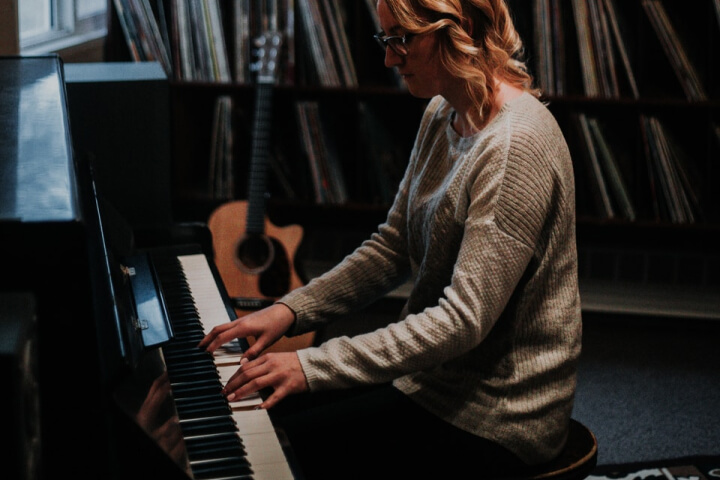
~How to Practice… Like a Professional!!
Practicing piano like a professional means treating your time at the keyboard as deliberate, structured artistry: not just repetition, but refinement. This new season is about taking everything we built together last year and elevating it: cleaner technique, deeper focus, smarter routines, and a more intentional relationship with the instrument.
In last year’s work, we learned how to show up consistently, how to break pieces into sections, how to listen for tone, how to correct tension, and how to practice slowly with purpose. Now you’re stepping into the next tier: practicing with a clear plan, tracking progress, shaping phrases with awareness, and using technique exercises to directly support your repertoire.
It’s the shift from “doing the work” to crafting your musicianship, where every session feels like a step toward mastery rather than maintenance.
~Step by Step~
Practicing piano like a professional is about adopting the habits that elite players use — the ones that make progress inevitable, efficient, and artistic. It’s not just “more practice,” it’s smarter practice, where every minute has intention and every choice supports long‑term mastery. Here are the core steps professionals rely on:
🎹 1. Start with the hardest section — often the last page
Professionals don’t begin at measure one. We go straight to the climax, cadenza, or final page because:
- that’s where fatigue and tension show up
- that’s where technical demands peak
- mastering the ending gives confidence for the whole piece
Everyone knows my story about the 16-page piece that I never learned the last page. So this year, we are going to start with our endings first. Why? Because if the last part is the best part, that’s your standing ovation!
🎼 2. Break the piece into micro‑sections
Instead of practicing long stretches, we work in 2–4 measure units. Small sections = faster mastery and cleaner technique. Two measures is easier than 16 pages!
🐢 3. Practice slowly — slower than feels comfortable
I always say “every note is a whole note” slow. Slow practice is the secret weapon. It builds accuracy, relaxation, and tone. Professionals spend more time slow than fast.
🔁 4. Use “loop practice” for difficult spots
Repeat a tiny section 5–10 times with perfect form. Not mindless repetition — high‑quality repetition. (Ok fine, 3 times is enough but if you did 5, you would hit the next level. This is what I’m shooting for this year!)
🧠 5. Hands Separate until the brain is fully mapped
Hands Separate practice builds clarity, reduces tension, and prevents sloppy Hands Together habits. In class, I like to play the other hand which adds even more complexity for duet thinking.
🎧 6. Listen like a recording engineer
Professionals listen to themselves while they are playing. Listen for:
- unevenness
- tension
- tone quality
- voicing
- pedal clarity
They don’t just play — they evaluate.
✍️ 7. Mark the score intentionally
Fingerings, phrasing, breaths, pedal changes, structural cues. A professional score looks lived‑in. Keep a pencil at the piano! And if you’re not marking it up, I am 🙂
🧩 8. Connect technique to repertoire
Scales, arpeggios, and cadences aren’t separate. They’re chosen to support the piece you’re learning. Play these as a warmup!! I often make sure we are practicing the exact key signature as the recital piece so that it supports the learning, knowledge and memorization of the piece.
🕊️ 9. End every session with a run‑through at 70–80% tempo
Not full speed — controlled, musical, and relaxed. This builds performance reliability.
🌿10. Track progress like a craftsperson
Professionals keep notes:
- what improved
- what still needs work
- what tomorrow’s focus will be
This turns practice into a structured path rather than a guessing game. We use our notebooks for this. Don’t forget to bring one to class!
🌿 Emotional Presence
~Whatever you practice, will show up in performance~
Practicing confidence, and refusing to rehearse fear, is one of the most important skills a professional pianist develops. It’s not just about playing the notes; it’s about shaping the internal state you bring to the instrument. Professionals know that whatever you practice emotionally will show up in performance. If you practice with hesitation, tight shoulders, shallow breathing, or the belief that you’re “probably going to mess up,” your nervous system learns that pattern just as surely as it learns scales. Fear becomes muscle memory.
Confidence, on the other hand, is not a mood: it’s a trained physical and mental ritual. Professionals build it deliberately.
- They practice the feeling of ease: slow breathing, grounded posture, relaxed hands, and a steady pulse.
- They practice continuity — moving forward even when something isn’t perfect.
- They practice trust — letting their preparation carry them instead of micromanaging every moment.
- They practice performance states during daily sessions: imagining an audience, playing through without stopping, and embracing the sensation of being seen.
Removing fear isn’t about forcing bravery; it’s about replacing the fear‑pattern with a confidence‑pattern. You train your nervous system to associate the piano with steadiness, breath, clarity, and forward motion. You practice the feeling you want to perform. And over time, confidence becomes the default — not because you “feel brave,” but because you’ve rehearsed it into your body.
During class, we work on all of the above, even bringing my husband (or the dogs!) in as an imaginary audience to practice what it feels like. It takes a long time, but your kids will learn these skills above and be able to practice and perform like the masters!
~Listening~
Gershwin’s Piano Concerto in F is a vibrant fusion of classical architecture and jazz spirit, weaving blues harmonies, rhythmic swagger, and symphonic sweep into one of the most electrifying concertos of the twentieth century.
To practice it like a professional, a pianist must treat the score as both a classical concerto and a jazz performance—drilling technical clarity, rhythmic precision, and orchestral balance while also cultivating the flexible swing, color, and improvisatory energy that give Gershwin’s writing its unmistakable pulse.
Daniil Trifonov embodies this duality with confidence, bravery, and emotional brilliance, playing as though he is stepping straight through fear into a kind of liberated, incandescent expression.
Click below to hear his amazing performance with the Philadelphia Orchestra: