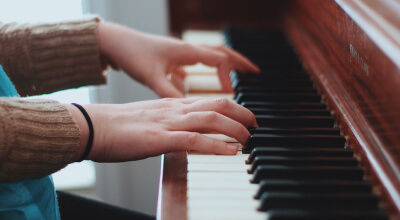
Piano Technique is the physical foundation of playing the instrument. It’s the way your body, hands, fingers, arms, and even breath work together to produce sound with ease, control, and expression. It’s not just “playing fast” or “playing accurately.” Technique is the craft beneath artistry: the mechanics that make musical ideas possible. It is your body’s connection to the instrument. And we work on this connection from the very first lesson.
🎹 What Piano Technique Actually Includes
Each component is a physical skill you build over time:
- Posture & Alignment — how you sit, how your arms hang, how your shoulders stay free. Good technique begins before you touch a key. We use our whole body.
- Hand Shape & Finger Strength — gently curved fingers, flexible knuckles, and balanced weight so you can play evenly without tension. We use a soft, relaxed palm without tightness to prevent injury.
- Arm/Body Action & Tone Production — overcoming gravity with no arm weight to create warm, light resonant sound instead of forcing with heavy fingers & arms. This comes from engaging the back muscles to move the upper arm and place each playing finger into it’s playing posture.
- Scales & Arpeggios — the core patterns that build speed, agility, and coordination. This includes playing from your feet, legs and your back muscles!
- Articulation Control — legato, staccato, portato, repeated notes, and the ability to switch textures instantly. We use the torso & back so the fingers can lift then drop; no pushing for these different textures. The fingers are then “played” by the key!
- Independence & Coordination — hands working separately and together, each with its own dynamic, rhythm, or articulation.
- Pedaling Technique — clean changes, half‑pedal, flutter pedal, and color pedaling.
- Velocity & Relaxation — learning to move quickly without tightening muscles. I think of this as using the correct muscles of the whole body, not just fingers.
- Repetition & Endurance — building muscular stamina for long passages or large works.
🌿 Why Technique Matters
Technique is what lets you express emotion without physical struggle. It’s the difference between wanting to play something and being able to play it. When technique is strong, the piano feels like an extension of your body — responsive, fluid, and capable of translating your creative imagination into sound.
~Technique Listening~
Czerny’s Op. 740 Études are the purest embodiment of technical discipline at the piano; a rigorous, almost architectural training ground where every measure is designed to strengthen a specific mechanical skill. Op. 740 is unapologetically about precision, consistency, and control.
Each étude isolates a core technical demand: velocity, double notes, repeated notes, wide leaps, articulation, or endurance and pushes the pianist to master it with absolute evenness and clarity. There is no interpretive “escape hatch” in these pieces; the technique must be clean, honest, and repeatable. In this way, Op. 740 functions like a conservatory‑level boot camp: it builds the muscular reliability, finger independence, and mental focus that make advanced repertoire possible, transforming raw effort into disciplined, dependable technique.
Czerny is not “concert difficulty”, he is technical infrastructure. His exercises build:
- evenness
- velocity
- articulation
- coordination
- pattern fluency
Czerny is the gym: repetitive, mechanical, essential. He doesn’t ask for poetry; he asks for discipline. His work prepares the hands for Liszt, Chopin, and everything beyond.